Cupertino
Home of Apple Park and some of the strongest public schools in the country — a suburban grid where the price of a house is really the price of a school assignment.
A market anchored to one company and one idea
Cupertino’s housing economy is tied almost entirely to two forces: Apple, which puts a steady stream of high-earning engineers and executives into the buyer pool, and the public schools, which those buyers treat as a non-negotiable. Add an almost total absence of developable land — the city is boxed in by established towns and the foothills — and you get a permanent seller’s market.
The result is velocity. Homes routinely sell over asking, often in under two weeks, and a house can be worth a meaningful premium simply for sitting on the right side of a school-attendance line.
From the Valley of Heart’s Delight
Cupertino planned its way from orchards to global tech headquarters — deliberately, over a century.
- 1776
- A cartographer on the de Anza expedition names the creek Arroyo San José de Cupertino, for Saint Joseph of Cupertino. The name eventually attaches to the whole district.
- 1850s–1900s
- A rural settlement called the “West Side,” centered where Stevens Creek Road met Saratoga-Sunnyvale Road (now De Anza Boulevard). Vineyards, then vast orchards of French prunes, apricots, peaches, and cherries — the Santa Clara Valley at its “Valley of Heart’s Delight” peak.
- 1880s
- San Francisco lawyer John T. Doyle establishes the Cupertino Wine Co. on McClellan Road, formally giving the area its name. The interurban Peninsular Railway along Stevens Creek Road links the valley to San José and opens Monta Vista as an early housing tract.
- 1955
- The community incorporates on October 10, after a narrow vote — a defensive move to keep local control of zoning and taxes ahead of annexation by neighboring cities. It begins a long tradition of forward-looking land-use planning.
- Early 1960s
- Landowners pool agricultural parcels to create the VALLCO business and industrial park, zoned explicitly for high-tech research and development — the decision that made everything after it possible.
- 1967 → 1977
- De Anza College opens and becomes the city’s de facto town square. A decade later Apple Computer relocates and expands into Cupertino, and the orchard town becomes a cornerstone of Silicon Valley.
The neighborhoods
In Cupertino, neighborhood boundaries are school boundaries. A quick orientation:
- Fairgrove
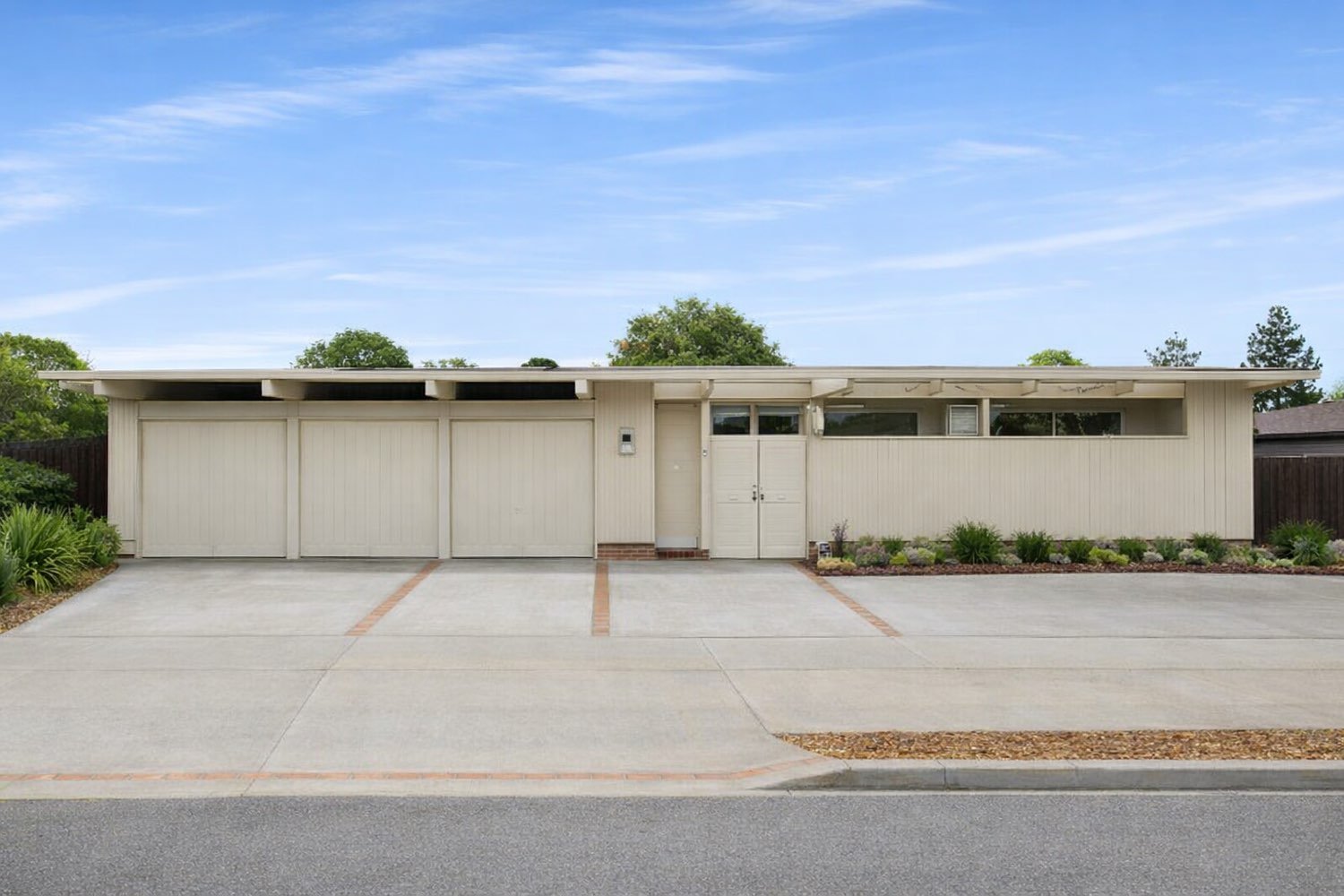
- Cupertino’s Eichler tract — roughly 200 post-and-beam homes built in 1960–61 near Bollinger and Miller, with the classic “Fair-” street names. Original atriums, radiant slabs, walls of glass. Our home turf.
- Monta Vista
- The premier micro-market, feeding Monta Vista High. Larger lots against the western foothills, the highest average prices, and the most intense bidding — homes near the Country Club regularly set the city’s high-water mark.
- Garden Gate & Jollyman
- Central and north Cupertino, served by Cupertino High and strong elementary and middle feeders. A high-value blend of academic premium, proximity to Apple Park, and the retail corridors.
- Seven Springs
- West of Foothill Boulevard — larger, more custom-built homes bordering the hills. Keeps the public-school premium but offers more square footage, lot size, and seclusion than the inner tracts.
Mid-century bones, constantly rebuilt
Cupertino was built out fast in the post-war boom. The original stock is mid-century — and much of it has been reworked at least once.
Eichler & mid-century modern
Concentrated in Fairgrove: post-and-beam frames, open-air atriums, floor-to-ceiling glass, radiant-heated slabs. Scattered MCM and Streng-style homes turn up elsewhere in the city. Our specialty.
Ranch-style homes
The dominant original type across the valley-floor tracts — single-story, efficient plans on standard lots. Most are prime candidates for a remodel or a full rebuild.
Modern custom rebuilds
Increasingly, older homes are replaced with large modern custom houses — 2,500+ sq ft, energy-efficient, indoor-outdoor — that push the price-per-square-foot on their block.
Lots & density
Standard lots run about a fifth to a third of an acre — a dense, highly valued suburb, not a rural escape. The larger, more secluded parcels are in the western foothills around Monta Vista and Seven Springs.
The reason the market never softens
In Cupertino, buying a home is buying school access. The public districts here perform at or above the private schools other Silicon Valley towns pay tuition for — so the premium goes into the house instead.
Public districts
Cupertino Union (K–8) & Fremont Union High (9–12)
- Consistently ranked among the best districts in the state and nation
- The primary magnet for ambitious families moving into the area
Monta Vista High & Cupertino High
- A+ grades from Niche; top-tier state and national rankings, especially in STEM
- Cupertino High averages roughly a 1420 SAT and a 32 ACT
- Monta Vista carries 20+ AP courses and heavy academic-olympiad participation
Regional private options
- The Harker School — K–12, research and mentorship programs, performing arts
- BASIS Independent Silicon Valley — rigorous K–12 STEM curriculum
- Fusion Academy — a 1-to-1 model for families wanting an alternative approach
Higher education
- De Anza College is in the city; Stanford and San José State are a short drive
Here, private school is usually chosen for a specific program or class size — not because the public option isn’t elite. It is.
A high-velocity seller’s market
Cupertino is defined by speed, not sprawl. Unlimited economic fuel meets a finite supply of houses, and the market clears in days.
- $3.0–3.2M
- Median sale price, Q3 2025
- 8–14
- Median days on market
- 104–108%
- Sale-to-list ratio, houses
- 70%
- Of houses sold over list, Q3 2025
Who's buying
Apple, Google, and HP engineers and executives; international buyers prioritizing academic pedigree; family trusts.
Velocity
Desirable school-zone homes go pending in under two weeks. Buyers act aggressively and often waive contingencies to win.
Pricing is a strategy
The risk isn't over-listing — it's failing to set a number that maximizes the bidding war. Mispricing shows up as days on market, which is fatal to value.
What's ahead
State housing mandates and tech-cycle volatility both press on the market. The through-line stays the same: proven school access holds its value.
Figures are directional and move with the market and the school zone. Ask us for a current, address-specific analysis.
Cupertino vs. the other elite enclaves
All three are prohibitively expensive. The choice is really about what you’re optimizing for.
- Cupertino
- “New global money,” achievement-driven. Fifth-to-third-acre lots on a dense suburban grid, ~$3.0–3.2M median. The differentiator is non-negotiable public-school access plus unmatched career proximity to Apple.
- Woodside
- “Old hidden money.” Rural and equestrian, multi-acre estates in the redwoods, ~$4M median. The differentiator is privacy and a genuine escape from the tech world.
- Los Altos Hills
- Bucolic, view-oriented. Large lots with strict zoning that preserves open space, ~$4.2M median. The differentiator is scenic tranquility and sweeping Bay views.
Engineered advantage
Cupertino clients treat a home purchase as a high-stakes investment in their family’s competitive edge. Our process is built to speak that language.
- School-boundary fluency. We track attendance lines down to the address, and price and market around the specific assignment a buyer is paying for.
- Data-driven pricing. Precise, aggressive list prices designed to generate multiple over-ask offers in the first seven to ten days — the window where the sale-to-list ratio peaks.
- Compass Concierge. We front the cost of staging, modernization, and curb appeal — paid back at close — to meet buyer expectations and drive four to eight percent over list.
- Off-market access. Compass Private Exclusives and our own network surface homes inside the Monta Vista boundary before the public bidding war starts.
- Non-contingent offer strategy. Deep comp data tells buyers the exact number that wins without overpaying past the next bidder, plus pre-emptive inspections and financing to make the offer the most certain on the table.
- Fiduciary & trust experience. Decades of complex family-trust, probate, and executive-relocation transactions, handled with discretion.
The track record: 2,100+ homes and $2.1B+ in sales volume across Silicon Valley — a data-driven system that scales.
Buying or selling in Cupertino?
In an eight-day market, a single decision can be the difference between winning a school-zone home and starting over. Start with a conversation.